Product Case · People Analytics
Flight risk only showed up after the exit interview — once the decision to leave was already final, leaving no room for intervention.
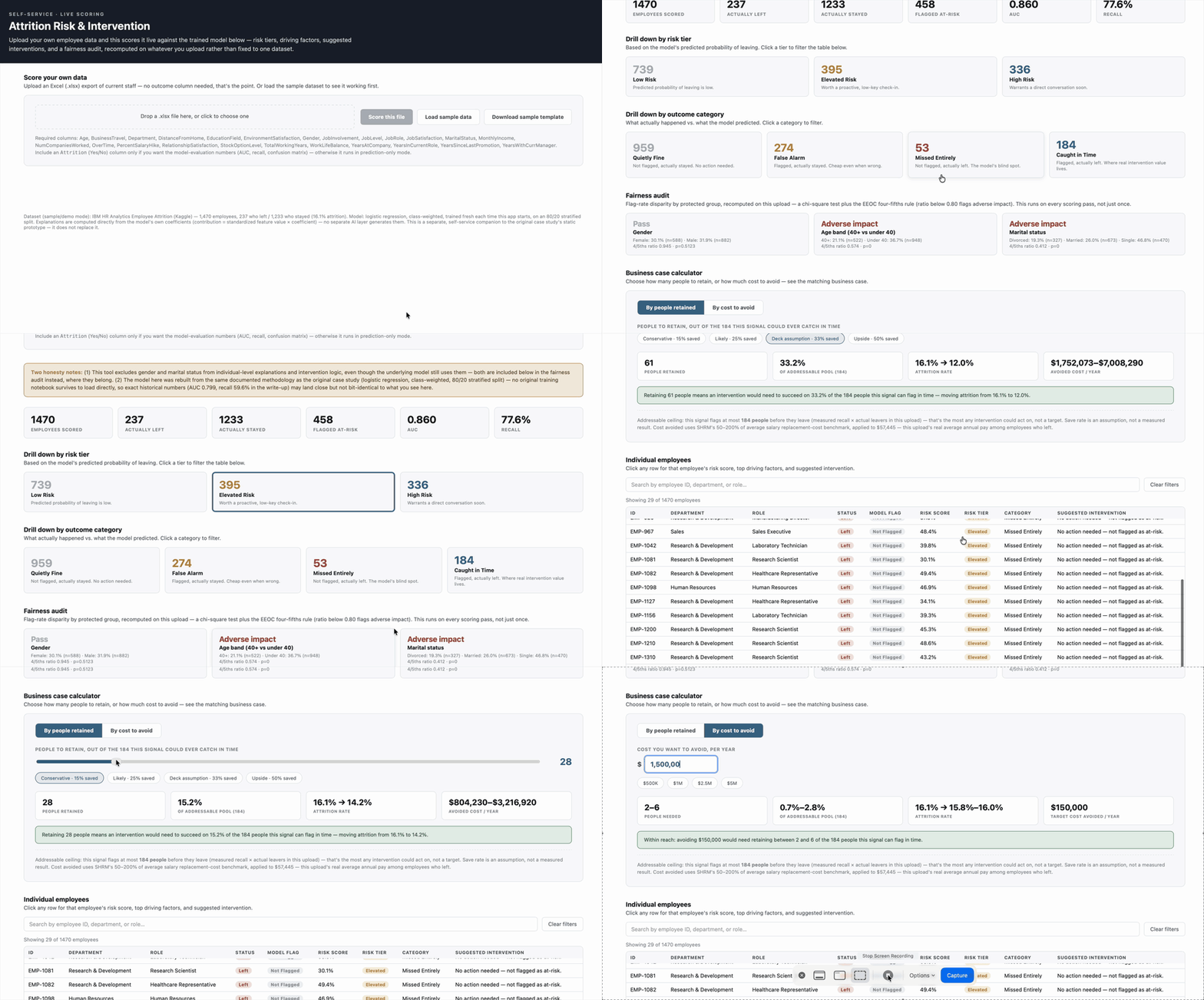
Attrition ran at 16.1% — 237 of 1,470 employees — and HR only learned who was at risk from a quarterly report or a resignation letter, after the decision was already made and replacement cost was already in motion. I built a model that scores every employee's flight risk and matches each one to the right response, before they hand in notice — catching 6 in 10 leavers early enough to act.
Two things that were broken
Attrition showed up in a quarterly report or an exit interview — after the decision to leave was already made and replacement cost was already in motion.
A model that predicts "everyone stays" is 84% accurate and catches nobody. Optimizing for accuracy would have missed exactly the people worth catching.
What we changed
- Designed a response for every risk tierA quiet check-in at low risk, a real retention conversation in the middle, escalation to manager and HR when risk and value are both high — never a blanket action.
- Scores every employee, continuouslyReplaces after-the-fact discovery with a live risk score for every employee, not just the ones who already gave notice.
- Proven on people it had never seenTested on 294 employees held back from training — the score holds up on people the model has never met.
- Explains itselfHR sees the risk tier, the suggested action, and why the model flagged that person — never just an unexplained number.


How interventions get prioritized
A risk score alone doesn't tell HR who to act on first — a junior individual contributor and a hard-to-replace senior engineer can carry the same risk score but very different consequences if they leave. Prioritization runs on a Risk × Impact matrix — the standard framework for allocating limited attention under constraint, adapted here to flight-risk score × role/replacement value, instead of treating every flagged employee the same.
No action. Logged for quarterly trend tracking so a slow drift doesn't go unnoticed.
A light, proactive touch even without a strong signal — the role is too costly to lose to justify waiting for one.
A real conversation within two weeks. The human still makes the call on what's offered.
Risk and value are both high at once — the costliest miss to allow, so it's routed to both immediately, not queued.
What it moved
Dataset: IBM HR Analytics Employee Attrition (Kaggle) · 1,470 employees. Trained on an 80/20 stratified split, so the same 16.1% attrition rate held in both the training data and the 294 held-out test employees the model never saw.
Go deeper
Why this model over a random forest, and the four numbers that matter.
Read the full breakdown → Method Model Evaluation 84% accurate, 0% recall · the baseline trapWhy recall beat accuracy, and how the test set was built.
Read the full breakdown → Business Case Workforce Analytics $290K–$1.1M · 47 leavers, 4 scenariosHow the flagged group breaks into four real outcomes, and what each one costs or saves.
Read the full breakdown → Responsible AI Fairness & Adverse-Impact Audit Gender passes · age fails the 4/5ths ruleA chi-square test on the flagged population — clean on gender, a real disparate impact on age.
Read the full breakdown →